Data Plane Packet processing with eBPF
This document explains the key concepts behind packet Ella Core's packet processing. It covers the components, workflow, and technologies used in the data plane. We refer to the data plane as the part of Ella Core that processes subscriber data packets.
eBPF and XDP
eBPF is a technology that allows custom programs to run in the Linux kernel. eBPF is used in various networking, security, and performance monitoring applications.
XDP provides a framework for eBPF that enables high-performance programmable packet processing in the Linux kernel.
Data Plane Packet processing in Ella Core
Ella Core's data plane uses XDP to achieve high throughput and low latency. Key features include:
- Packet filtering: Applying rules to determine whether packets should be dropped, forwarded, or passed.
- Encapsulation and decapsulation: Managing GTP-U (GPRS Tunneling Protocol-User Plane) headers for data transmission.
- Rate limiting: Enforcing Quality of Service (QoS) with QER (QoS Enforcement Rules).
- Statistics collection: Monitoring metrics such as packet counts, drops, and processing times.
Data plane processing in Ella Core occurs between the n3 and n6 interfaces.
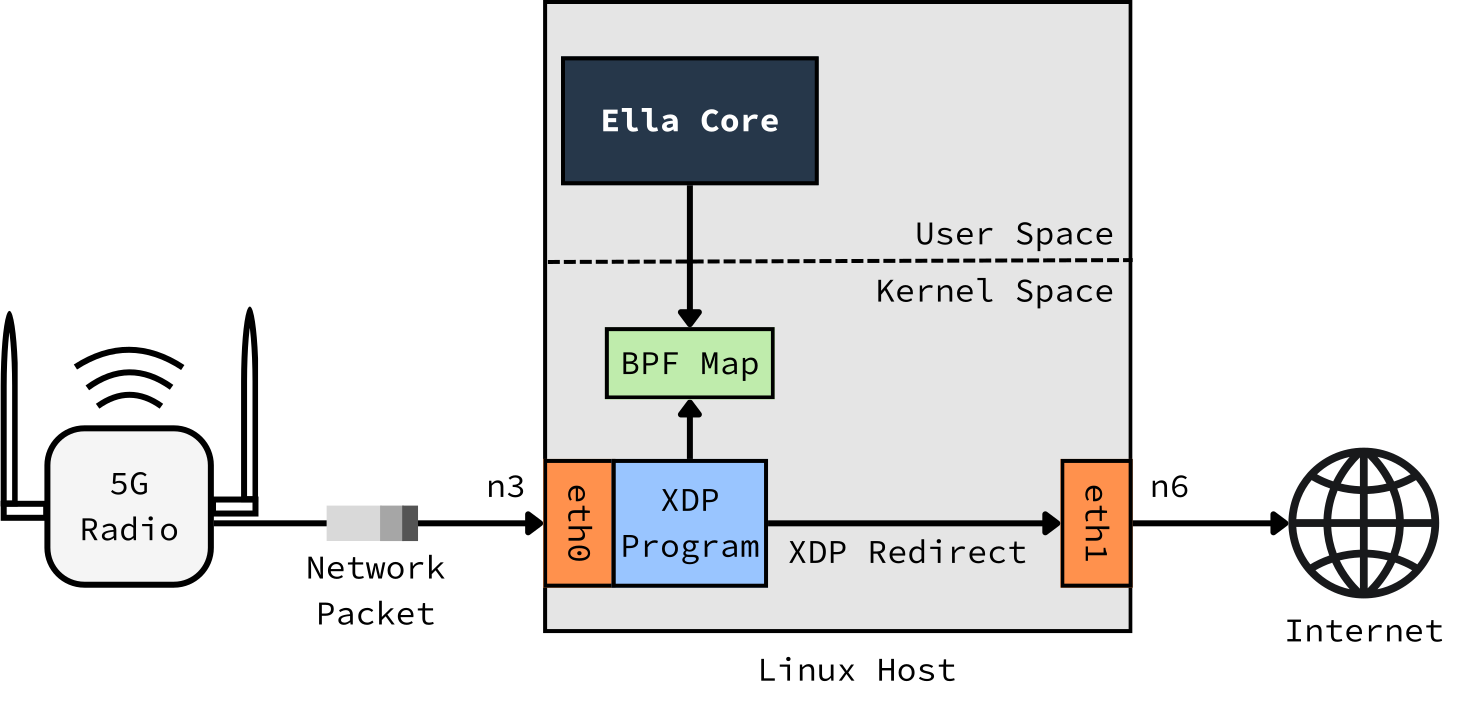
Routing
Ella Core currently relies on the kernel to make routing decisions for incoming network packets. Kernel routes can be configured using the Networking API or the user interface.
NAT
Network Address Translation (NAT) simplifies networking as it lets subscribers use private IP addresses without requiring an external router. It uses Ella Core's N6 IP as the source for outbound traffic. Enabling NAT adds processing overhead and some niche protocols won't work (e.g., FTP active mode). You can enable NAT in Ella Core by navigating to the Networking page in the UI and enabling the NAT option or by using the Networking API.
Performance
Detailed performance results are available here.
Configuration
Ella Core supports the following XDP attach modes:
- Native: This is the most performant option, but it is only supported on compatible drivers.
- Generic: A fallback option that works on most drivers but with lower performance.
For more information on configuring XDP attach modes, refer to the Configuration File documentation.
XDP redirect on veth pairs
When Ella Core's N3 interface is a veth pair (e.g. in co-hosted deployments), the XDP data plane uses bpf_redirect() to forward downlink packets from N6 to N3. In native XDP mode, this requires an XDP program on both sides of the veth pair.
Without an XDP program on the receiving peer, the veth driver will not deliver redirected frames through the native path and the frames will be dropped.
The solution is to attach a minimal XDP program that returns XDP_PASS to the peer veth. This satisfies the kernel's requirement and keeps packets on the fast native XDP path. See Use native XDP with veth interfaces for setup instructions.