Architecture
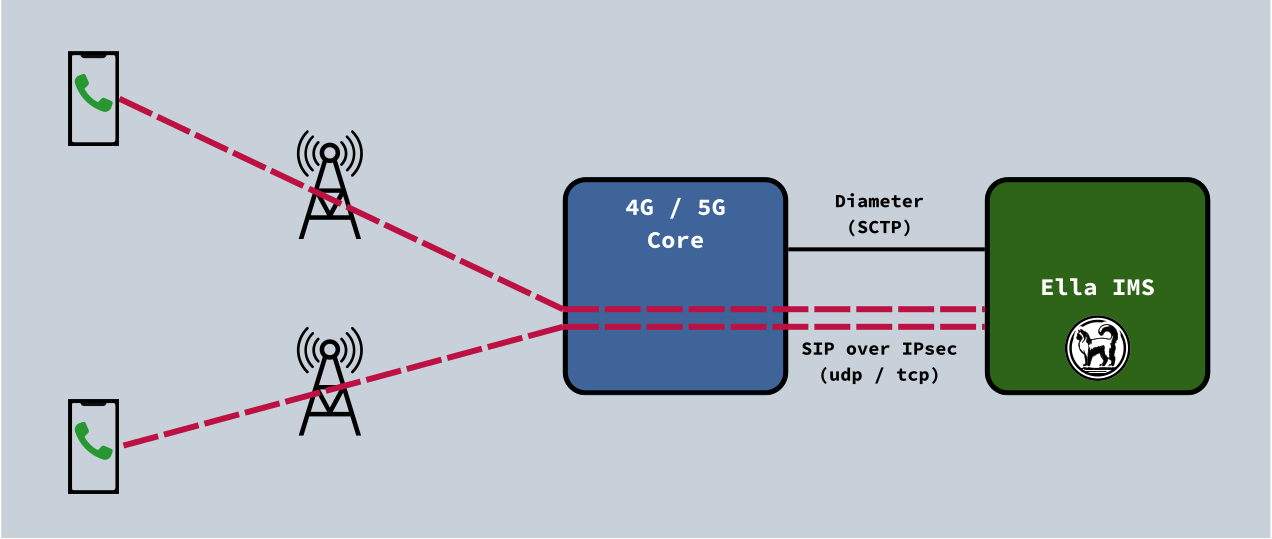
An IP Multimedia Subsystem (IMS) is what lets phones on a 4G or 5G network make voice and video calls. The core network gives each phone an IP connection to the IMS. Over that connection, the phone registers and places calls with SIP, and the IMS routes them.
Three CSCFs in one process
3GPP splits the IMS's SIP routing into three Call Session Control Functions (CSCFs):
- P-CSCF: the phone's first contact. It protects the phone's signalling with IPsec, and asks the core network for the QoS that voice and video need.
- I-CSCF: the entry point of the network. It asks the HSS which S-CSCF serves a user.
- S-CSCF: the registrar. It authenticates phones against the HSS, routes calls, and involves Application Servers when a subscriber's filter criteria say so.
In most IMS deployments, these are separate nodes. Ella IMS runs all three in one process, with one database, one UI and one API. Each CSCF still has its own SIP port, and the three exchange standard SIP messages, in memory, so from the outside Ella IMS looks like any other IMS.
What Ella IMS relies on
Ella IMS stores no subscribers. It relies on two functions of the core network:
- The HSS holds the subscribers: their identities, the keys to authenticate them, and the filter criteria that bring in Application Servers. Ella IMS reaches it over Diameter (Cx).
- The policy function has the core set up the dedicated bearers (4G) or QoS flows (5G) that carry voice and video. Ella IMS reaches it over Diameter (Rx), or a PCF over HTTP (N5).
Ella Core provides both. For how it works with an IMS, see Ella Core's IMS Integration.
Standards
Ella IMS follows 3GPP standards. It should work with any compliant 4G or 5G core, Application Server and phone, beyond those it was validated against.