Data Plane Packet processing with eBPF
This document explains the key concepts behind Ella Core's subscriber data packet processing.
Ella Core processes subscriber packets between the N3 / S1-U and N6 / SGi interfaces.
eBPF, XDP, and TCX
eBPF lets custom programs run in the Linux kernel, and is widely used in networking, security, and performance monitoring.
Ella Core's data plane is an eBPF program, attached at one of two kernel hooks:
- XDP runs in the network driver, before the kernel builds a socket buffer, and requires driver support.
- TCX runs later on the socket buffer and is available on every interface.
Attach modes covers the trade-off.
Data Plane Packet processing in Ella Core
Ella Core's data plane uses eBPF to achieve high throughput and low latency. Key features include:
- Policy rules enforcement: Evaluating ordered per-policy uplink and downlink rules to allow or deny traffic based on remote prefix, protocol, and port range.
- Encapsulation and decapsulation: Managing GTP-U (GPRS Tunneling Protocol-User Plane) headers for data transmission.
- Rate limiting: Enforcing Quality of Service (QoS) with QER (QoS Enforcement Rules).
- Flow reporting: Recording per-flow traffic details including source, destination, protocol, port, and whether the flow was allowed or dropped.
- Usage reporting: Aggregating per-subscriber byte counts for data usage tracking.
- Statistics collection: Monitoring metrics such as packet counts, drops, and processing times.
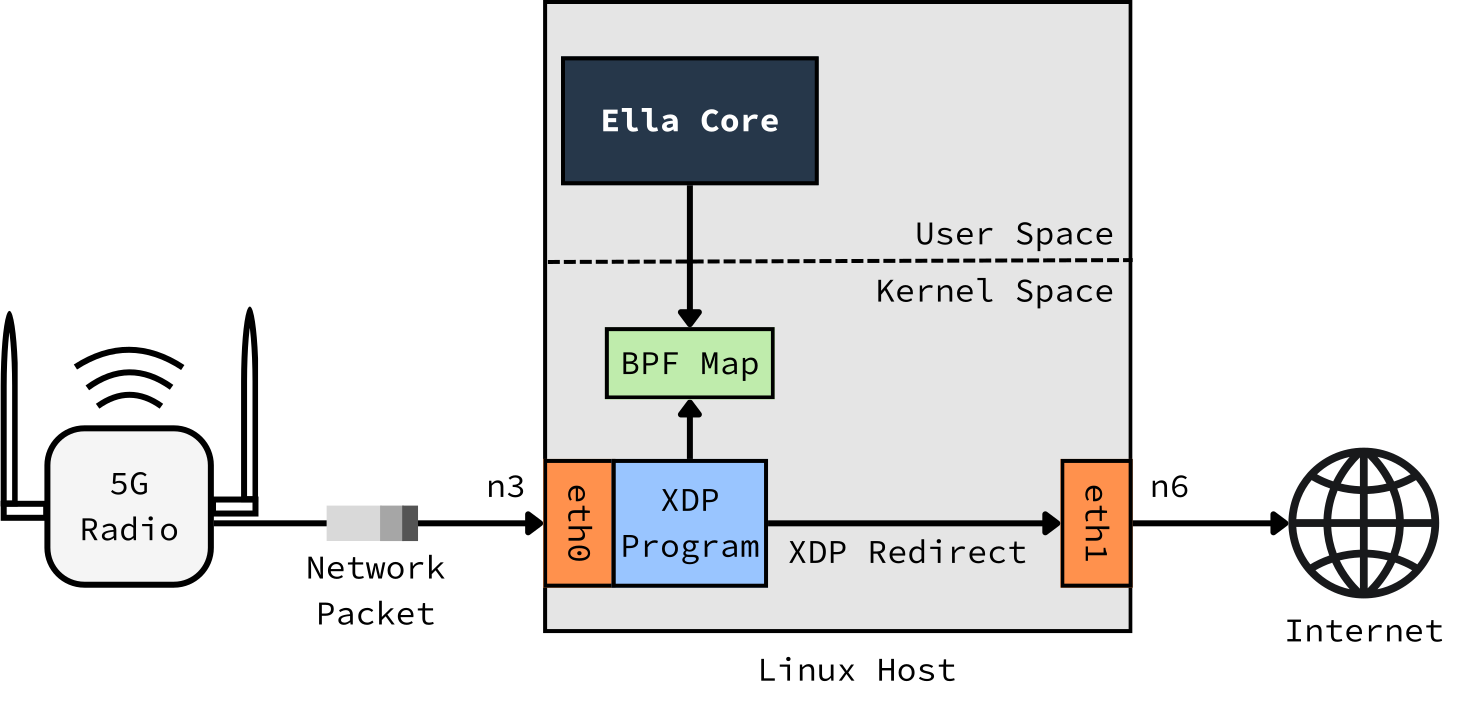
Routing
Ella Core relies on the kernel to make routing decisions for incoming network packets. Kernel routes can be configured using the Networking API or the user interface.
Performance
Detailed performance results are available here.
Attach modes
The data plane can attach at either of two kernel hooks:
-
xdp-native runs in the network driver, before the kernel builds a socket buffer. It is the fastest option, but it needs a driver that supports the hook.
-
tcx runs on the socket buffer, after the kernel's receive path. It is available on every interface, including the veth pairs used in containers and co-hosted deployments. It is the option that always works.
Why merged packets must be disabled
tcx runs on the socket buffer, which can hold several packets merged together by the kernel's receive path. Ella Core can't produce a valid GTP-U header from a merged buffer: it writes one GTP-U header sized for the whole buffer, and when the kernel splits the buffer back into wire-sized packets it rebuilds the outer IP and UDP headers but not the GTP-U header, so every packet claims the whole buffer's payload length.
Disable merged packets on N3 and N6.
XDP redirect on veth pairs
When Ella Core's N3 or N6 interface is a veth pair, the data plane redirects packets out of it. In xdp-native mode the veth driver delivers redirected frames only when the receiving peer has an XDP program attached or GRO enabled; otherwise they are dropped. Attaching a minimal XDP_PASS program to the peer is the usual fix. See Use native XDP with veth interfaces for the steps.
IPv6 GTP-U transport
GTP-U tunnels on N3 / S1-U run over either IPv4 or IPv6. The inner UE payload family is independent of the outer header family.
Which family is used depends on the interface configuration and on the radio. When N3 is set by name, Ella Core advertises both of the interface's addresses and the radio picks one. When both sides support both families, IPv6 is used. To pin a family, configure N3 with an address of that family.